
 Pin it
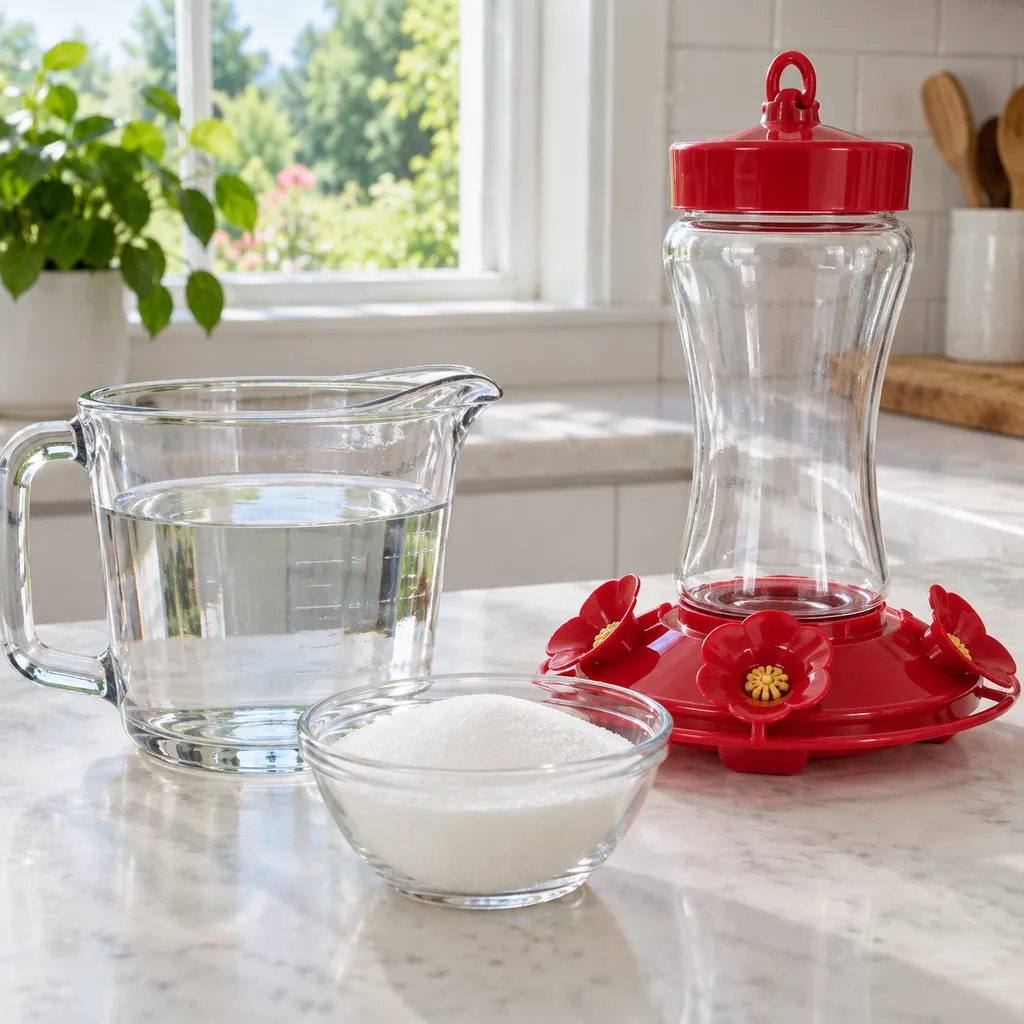
The best sugar for hummingbird food is plain white table sugar mixed with water at the 4:1 ratio: 1 part sugar to 4 parts water. That simple mix is the standard because it dissolves into clear sugar water without extra minerals, molasses, starches, coloring or non-caloric sweeteners. Smithsonian’s National Zoo lists refined white sugar and water as the ingredients for hummingbird nectar, and Cornell Lab’s All About Birds also recommends table sugar rather than honey for homemade hummingbird food (Smithsonian National Zoo, All About Birds).
The Short Answer: Use Plain White Table Sugar
Plain white table sugar is the right choice because it is mostly sucrose, the same main sugar hummingbirds commonly encounter in many flower nectars. For backyard feeding, the goal is not to improve on flowers or make a richer syrup. The goal is to offer a clean, predictable supplemental nectar that does not add substances the birds do not need.
Look for a bag labeled white granulated sugar or refined white sugar. In everyday kitchen language, that is ordinary table sugar. It should be dry, white, free-flowing and unflavored. If the package says brown sugar, raw sugar, turbinado, demerara, powdered, confectioners, coconut sugar, maple sugar or a sugar substitute, leave it out of hummingbird nectar.
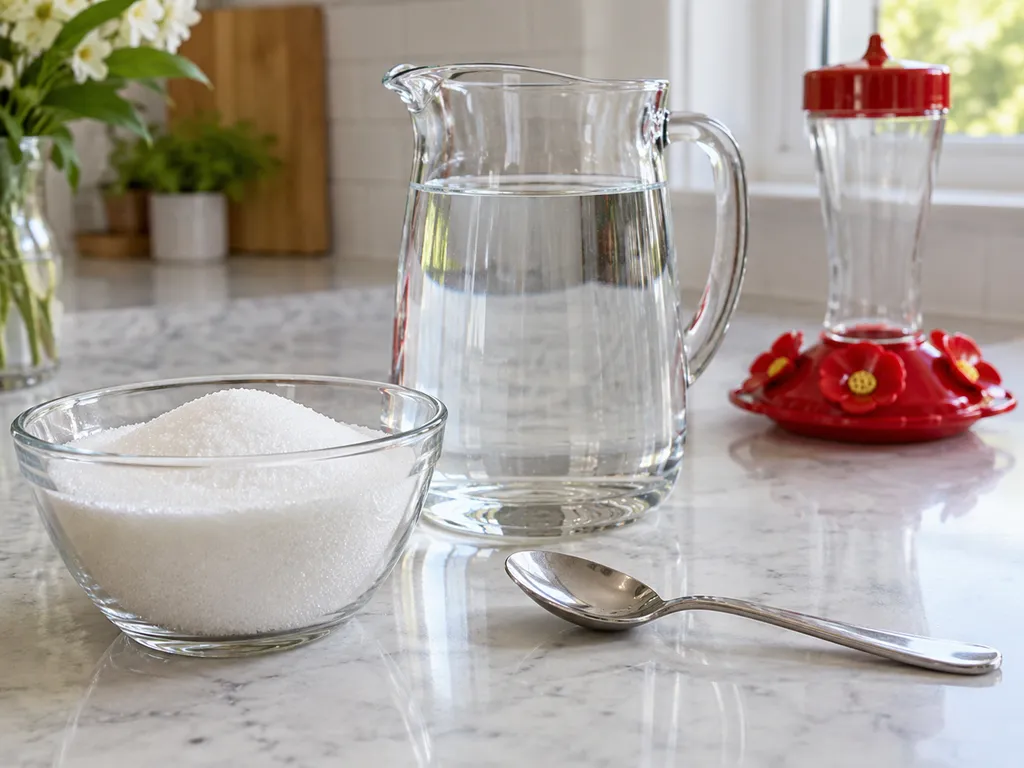
The standard mix is the 4:1 ratio: 1 part plain white sugar to 4 parts water. A part can be any measure you choose. For a small batch, use 1/4 cup sugar and 1 cup water. For a larger batch, use 1 cup sugar and 4 cups water. Stir until fully dissolved, let the nectar cool if you warmed the water, and fill only a clean feeder.
Why the 4:1 Ratio Matters
The 4:1 ratio is strong enough to be attractive and useful without turning the feeder into syrup. Smithsonian’s directions use 1 part sugar with 4 parts water and tell readers not to add red dye; Audubon’s hummingbird feeding FAQ also points readers to refined white sugar and tap water for feeder nectar (Audubon Hummingbird Feeding FAQs). Keeping the recipe steady also makes the routine easier: the same mix works in spring, summer, fall and winter wherever hummingbirds are being fed.
A common mistake is to make the mixture stronger during migration or cold weather. Do not make that your rule. Hummingbirds need reliable, fresh nectar more than they need a backyard syrup that keeps changing. If you want to help during busy seasons, the better move is to keep the feeder clean, refresh the nectar on schedule, and support native tubular flowers that provide natural nectar and tiny insects nearby.
Safe Sugar Checklist
Use this quick check before you mix a batch:
- Use: plain white table sugar, also called refined white granulated sugar.
- Use: clean water. Tap water is generally fine unless your local water supply has a specific advisory.
- Keep: the 4:1 ratio in every season.
- Skip: red dye, food coloring and colored commercial mixes.
- Skip: honey, corn syrup, maple syrup, agave, molasses, fruit juice and sports drinks.
- Skip: brown sugar, raw sugar, turbinado sugar, organic sugar and powdered sugar.
- Skip: stevia, sucralose, aspartame and all other artificial sweeteners.
- Skip: vitamin, mineral or protein additives.
Why Honey Does Not Belong in Hummingbird Food
Honey may sound natural, but it is the wrong ingredient for a hummingbird feeder. Once diluted with water, honey changes quickly and can support unwanted microbial growth. Cornell Lab’s All About Birds explains that diluted honey allows bacteria and fungus to thrive, while Audubon warns readers not to substitute honey in hummingbird nectar (All About Birds, Audubon nectar recipe).
There is also no benefit to honey in this use. A feeder is not a flower, and honey is not flower nectar. It brings a different mix of sugars and other compounds, and it spoils faster than plain sugar water. If a feeder has been filled with honey water, empty it, wash it thoroughly, clean the ports, rinse well, and start again with plain white sugar and water.
Why Brown, Raw, Turbinado and Organic Sugars Are Poor Choices
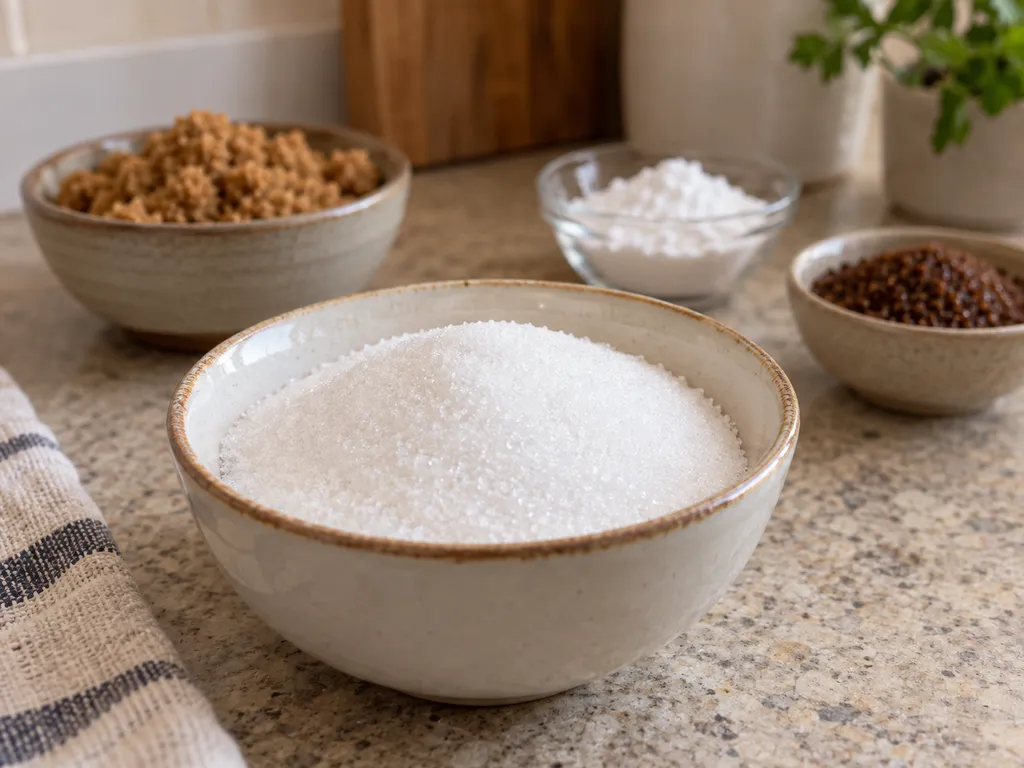
Brown sugar, raw sugar, turbinado sugar and similar less-refined sugars carry molasses or trace materials that do not belong in hummingbird nectar. That is the very thing that gives these sugars their tan color and deeper flavor for human baking. In a hummingbird feeder, those extras are not an advantage. The cleanest choice is the plain white granulated sugar recommended by bird-focused authorities.
Organic sugar can be confusing because the word sounds reassuring. For hummingbird food, the important question is not whether a sugar was grown under an organic standard. The important question is whether it is plain, refined, white granulated sugar without color, molasses flavor or extra ingredients. Many organic sugars sold for kitchen use are less refined and tan rather than bright white, so they should be avoided for nectar.
Why Powdered Sugar and Artificial Sweeteners Are Out
Powdered sugar is not just finely ground table sugar. It often contains cornstarch or another anti-caking ingredient, which is why Smithsonian specifically says powdered sugar is not recommended for hummingbird food (Smithsonian National Zoo). Those added ingredients are useful in frosting, not in a nectar feeder.
Artificial sweeteners are also wrong for a very simple reason: they do not provide the same energy source as sugar. Hummingbirds visit feeders for sugar water that supplements nectar from flowers. A no-calorie sweetener may taste sweet to people, but it does not serve the feeder’s purpose. This includes stevia, sucralose, aspartame and tabletop sweetener blends.
Red Dye Is Unnecessary
Hummingbird nectar should be clear, not red. Natural flower nectar is clear, and the red or orange parts of a feeder are enough visual signal. Cornell Lab says there is no reason to add red dye because feeders already use colorful parts to attract birds, and Smithsonian’s recipe also says not to add red dye (All About Birds on red coloring, Smithsonian National Zoo).
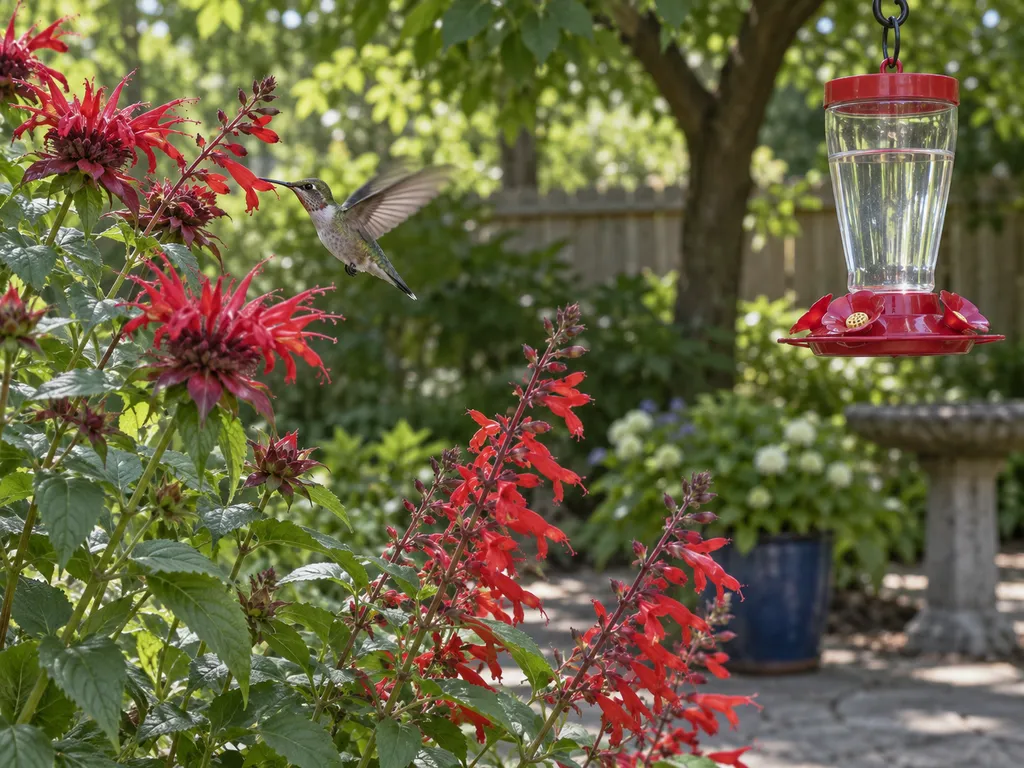
If your feeder has red flower ports, a red base or a red cap, you have already solved the visibility problem. If it does not, place the feeder near red, orange, pink or purple tubular blooms such as bee balm, cardinal flower, salvia, columbine or coral honeysuckle. Do not put coloring in the nectar itself.
Boiling Is Optional, Cooling Is Not
You do not have to boil hummingbird nectar for ordinary daily mixing. Smithsonian says the water does not need to be boiled as long as the sugar is fully dissolved. Cornell notes that small batches made every day or two do not need boiling, while larger batches intended for refrigerator storage can be made with boiling water (Smithsonian National Zoo, All About Birds).
Warm or hot water can make sugar dissolve faster, but the nectar must cool before it goes into the feeder. Hummingbirds should be offered room-temperature nectar, and a hot feeder can also expand and leak. Once the sugar has dissolved completely, let the mix cool, then fill the feeder with only as much as the birds are likely to finish before the next change.
Freshness Is Part of the Ingredient Choice
Even perfect sugar becomes a problem if the nectar sits too long. Sugar water ferments, clouds and grows mold faster in heat and direct sun. Smithsonian recommends changing feeders every other day and cleaning them each time, while Audubon advises daily or every-other-day cleaning in hot weather and less frequent changes in cooler conditions (Smithsonian National Zoo, Audubon Hummingbird Feeding FAQs).
As a practical home schedule, change nectar about every 1 to 2 days above 90°F, every 2 to 3 days in the 80s°F, and every 4 to 6 days in cooler weather. Replace it immediately if it looks cloudy or stringy, smells sour, or shows mold or black specks. Extra nectar can be stored in a clean, covered container in the refrigerator for up to about a week, but discard it sooner if anything looks or smells off.
Sugar Water Is Only One Part of Supporting Hummingbirds
A feeder is a supplement, not a complete backyard plan. Hummingbirds also feed from flowers and catch small insects and spiders, which are especially important when adults are raising young. Audubon’s hummingbird-friendly yard guidance highlights flowers, perches, insects and water as key parts of a supportive yard, and University of Illinois Extension also recommends nectar blooms and avoiding insecticides because hummingbirds eat insects (Audubon hummingbird-friendly yard, Illinois Extension).
For this reason, do not add protein powders, vitamins or supplements to feeder nectar. Those products make the feeder less predictable and are not needed in the sugar-water recipe. Let flowers and a pesticide-free yard do the broader work while the feeder supplies clean 4:1 nectar.
A Simple Mixing Routine That Avoids Most Problems
Measure the water first, then the sugar, so the ratio stays clear in your mind. Stir until no grains remain. If you warmed the water, let the nectar cool. Fill a clean feeder with a modest amount, store extra nectar covered in the refrigerator, and rinse the storage container before the next batch. Clean the feeder at every refill with hot water and a bottle brush, and clean the ports with a small brush or pipe cleaner.
For deeper feeder cleaning, use white vinegar diluted with water or a weak bleach solution of about 1/4 cup bleach per gallon of water, then rinse very thoroughly. A drop of mild dish soap is acceptable only if every part is rinsed extremely well. The sugar choice matters, but routine cleaning matters just as much because even correct nectar can spoil in a dirty feeder.
Bottom Line
If you remember one rule, make it this: plain white table sugar plus clean water at the 4:1 ratio. That is the safe, simple, evidence-backed standard for hummingbird food. Everything else that seems like an upgrade, including honey, brown sugar, raw sugar, red dye and sweeteners, makes the feeder less suitable rather than better.
The Bottom Line
Use plain white table sugar for hummingbird food and mix it with water at the 4:1 ratio. Keep the nectar clear, skip every alternative sweetener and dye, cool it before filling the feeder, and replace it often enough that it never turns cloudy, sour or moldy.
Frequently Asked Questions
Can I use cane sugar for hummingbird food?
Yes, if it is plain white granulated cane sugar. Do not use tan, raw, turbinado, brown or flavored cane sugars. The safe choice is refined white table sugar mixed with water at the 4:1 ratio.
Can I use organic sugar for hummingbird nectar?
Skip organic sugar for feeder nectar unless it is truly plain, refined, white granulated sugar. Many organic sugars are less refined and tan, which means they are not the right choice for hummingbirds.
Is powdered sugar okay for hummingbird food?
No. Powdered sugar often contains cornstarch or another anti-caking ingredient. Use plain white granulated sugar instead.
Should hummingbird nectar be red?
No. Hummingbird nectar should be clear. Red feeder parts and nearby tubular flowers provide visual attraction; dye does not belong in the nectar.
Do I need to change the sugar ratio in winter or migration season?
No. Keep the 4:1 ratio as the standard in every season. Help birds more by keeping nectar fresh, cleaning the feeder at every refill, and planting nectar-rich flowers where possible.
How long can homemade hummingbird food stay in the refrigerator?
Store extra nectar in a clean, covered container in the refrigerator for up to about a week. Discard it sooner if it looks cloudy, smells sour, or shows any mold.
Sources
This guide was researched using these sources.
- https://www.nationalzoo.si.edu/migratory-birds/hummingbird-nectar-recipe
- https://www.allaboutbirds.org/news/feeding-hummingbirds
- https://www.allaboutbirds.org/news/should-i-use-red-food-coloring-in-hummingbird-food
- https://www.audubon.org/magazine/hummingbird-feeding-faqs
- https://www.audubon.org/news/how-make-hummingbird-nectar
- https://www.audubon.org/community-science/hummingbirds/how-create-hummingbird-friendly-yard
- https://extension.illinois.edu/news-releases/gardening-hummingbirds-travels