
 Pin it
No, hummingbirds do not need red dye in nectar. The useful part of a feeder is the clear sugar-water solution, not the color of the liquid. Red feeder parts, nearby tubular flowers, and a consistent supply of fresh 4:1 nectar are enough to help birds investigate. Cornell Lab of Ornithology says natural flower nectar is clear and that there is no reason to add red dye to sugar water (source). The safest practical answer is simple: skip dye, mix plain white table sugar with water at the 4:1 ratio, and replace nectar before it spoils.
Why the short answer is no
Red dye is a human idea added to some commercial mixes and old backyard advice. It is not something hummingbirds require. In flowers, the bright signal is usually the flower itself, while the nectar is clear. Audubon gives the same basic answer in its hummingbird feeding FAQ: red coloring is not necessary, and natural nectar is a clear solution (source). The U.S. Fish and Wildlife Service also advises using table sugar and water only, and says not to add red dye or other additives to hummingbird sugar water (source).
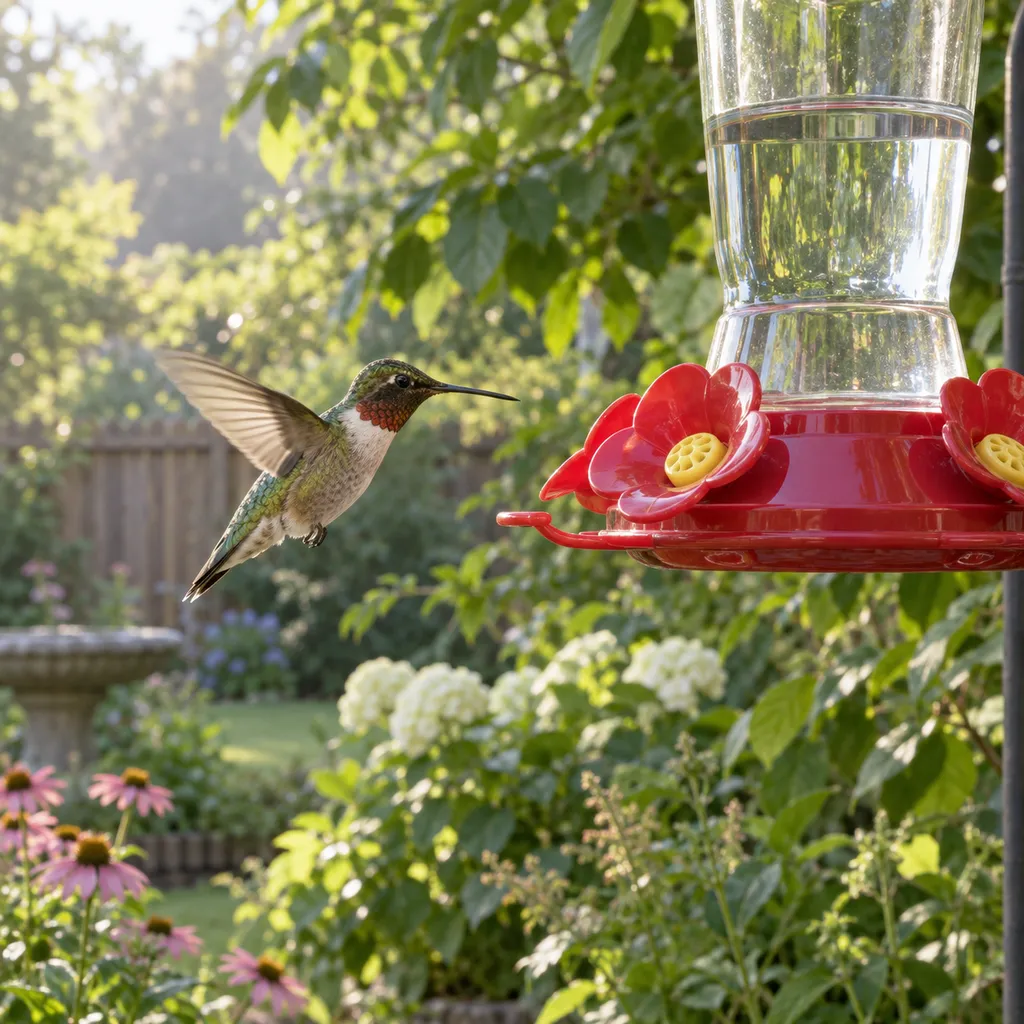
The better question is not whether dyed nectar looks more attractive to people, but whether it improves anything for the bird. The answer remains no. Hummingbirds are already adapted to find nectar sources by visual cues in the landscape, and many feeders include red caps, bases, or ports for that reason. Cornell notes that feeder color can catch a hummingbird's notice even when the sugar water is clear (source). Adding color to the liquid does not make the nectar more nourishing, more natural, or easier for a hummingbird to use.
What attracts hummingbirds if the nectar is clear?
Hummingbirds notice visual patterns, flower shape, food quality, and repeated reliable sources. A red feeder part may help the feeder stand out, but the liquid inside can stay clear. Cornell's Ruby-throated Hummingbird species account says these birds prefer red or orange flowers, while also noting that food coloring is unnecessary in feeder sugar water (source). In other words, the signal and the food are separate: the red object says “look here,” while the clear nectar provides energy.
Audubon has also summarized research and field observations showing that color is only part of the story. Hummingbirds can learn which sources give the better energy payoff, so a clean feeder with fresh nectar matters more than a colored solution (source). For a backyard setup, this means a red feeder base, red flower-shaped ports, or nearby red and orange tubular blooms can do the attracting work without changing the nectar itself.
The plain nectar formula to use instead
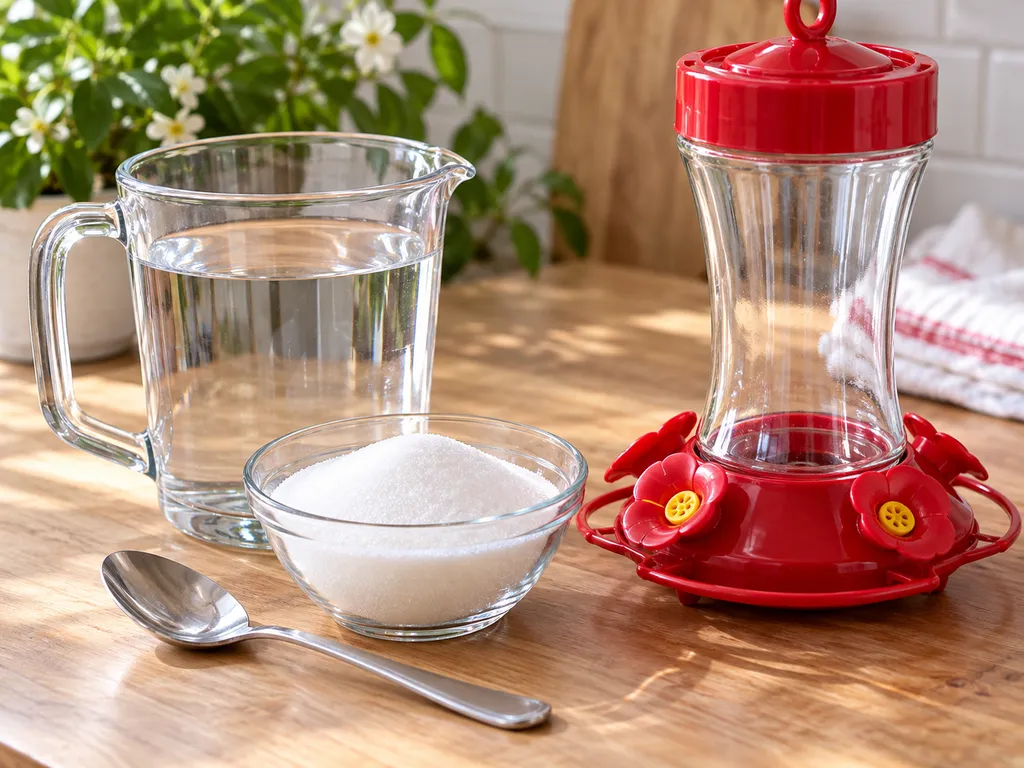
Use the 4:1 ratio: 1 part plain white table sugar to 4 parts water. That ratio is the standard home substitute for flower nectar on this site, and it is the one Fish and Wildlife Service materials give for hummingbird feeders (source). Boiling is optional for dissolving sugar; if you heat the water, let the nectar cool completely before filling the feeder. Store extra nectar in a clean, covered container in the refrigerator for up to about a week.
Keep the recipe boring on purpose. Do not add red dye, food coloring, honey, brown sugar, raw sugar, turbinado sugar, molasses, maple syrup, agave, fruit juice, sports drinks, artificial sweeteners, vitamin drops, or protein additives. Audubon advises refined white sugar and water, and says not to use red coloring, brown sugar, honey, molasses, or artificial sweeteners for hummingbird nectar (source). The value is in giving hummingbirds a predictable, clear sugar-water source that does not include unnecessary extras.
Why red dye remains a poor tradeoff
The case against red dye has two parts. First, it is unnecessary. Natural nectar is clear, and feeder parts or flowers can supply the visual cue. Second, bird authorities repeatedly advise against it because artificial coloring could pose risk and offers no benefit. Audubon states that there have not been scientific studies on artificial dyes in hummingbirds specifically, but still advises against dye because it is unnecessary and could pose risk; the same article says red, yellow, or orange feeder details are enough to grab attention (source).
That uncertainty is not a reason to experiment with dyed nectar. It is a reason to avoid the additive. Backyard feeding should reduce avoidable problems, not add ingredients that birds do not need. If clear nectar performs the same job, and the visual cue can come from the feeder or plants, then dye has no practical role. The simplest routine is also the most defensible one: clear 4:1 nectar, changed often, in a feeder that is cleaned at every refill.
How to make a feeder noticeable without dye
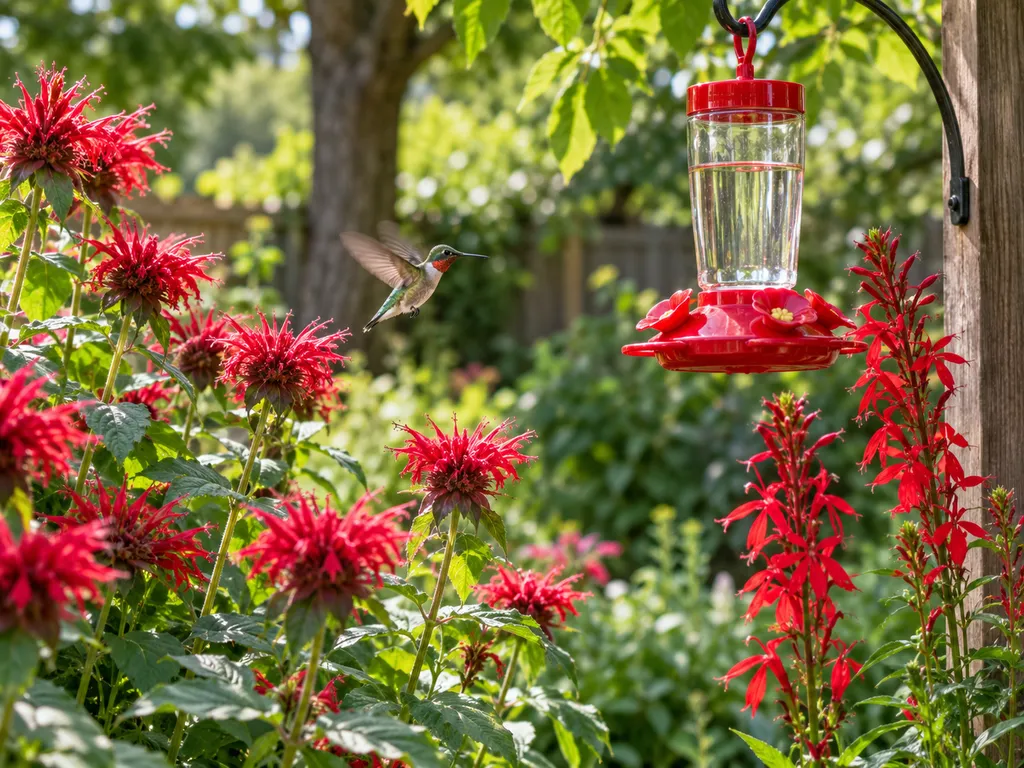
You can make a feeder easier to find while keeping the nectar clear. The goal is to provide a visible feeding station and surrounding habitat cues without putting color into the liquid. A few practical options are enough for most yards:
- Choose a feeder with red parts, such as a red base, cap, or flower-shaped ports.
- Hang the feeder where hummingbirds can approach safely, with some nearby cover but enough open space for flight.
- Plant tubular red, orange, pink, or purple flowers such as bee balm, cardinal flower, salvia, coral honeysuckle, penstemon, columbine, trumpet vine, or fuchsia where suitable for your region.
- Keep the nectar fresh so a bird that finds the feeder has a reason to return.
- Use multiple small nectar sources in active seasons rather than one large neglected feeder.
Flowers are especially useful because they support the broader pattern of hummingbird feeding. Feeders can supplement natural nectar, but they should not be the only attraction in a yard. Hummingbirds also take small insects and spiders, which are especially important when adults are raising young. A flower-rich yard can support both nectar visits and insect availability, while the feeder adds a clear, predictable sugar-water source.
What to do with red commercial mixes
If you already own a red commercial nectar mix, the conservative choice is not to use it. Products with artificial color do not solve a problem that clear 4:1 nectar leaves unsolved. Cornell says there is no reason to add red dyes to hummingbird sugar water because natural nectar is clear and feeders already use color to attract attention (source). Audubon similarly advises against dyed sugar water and notes that companies still sell products with artificial dyes despite the lack of need (source).
Powdered mixes can also make people less attentive to the actual ingredients. Some are simply sugar with coloring, while others may include additives that are not part of standard hummingbird nectar. You do not need the packet. Plain white table sugar and water are easy to measure, inexpensive, and transparent in every sense: you know exactly what is in the feeder. If you want the feeder to look more visible, use the red parts of the feeder, not red liquid.
Freshness matters more than color
A feeder filled with clear nectar is only helpful when the nectar is fresh. Sugar water can ferment or grow mold, especially in heat. Cornell's Ruby-throated Hummingbird page advises changing sugar water before it becomes cloudy or discolored and notes that hot weather speeds fermentation (source). The Fish and Wildlife Service recommends changing hummingbird sugar water every 3 to 5 days and more often in hot climates (source). For a practical yard schedule, change nectar about every 1 to 2 days above 90°F, every 2 to 3 days in the 80s°F, and every 4 to 6 days in cooler weather.
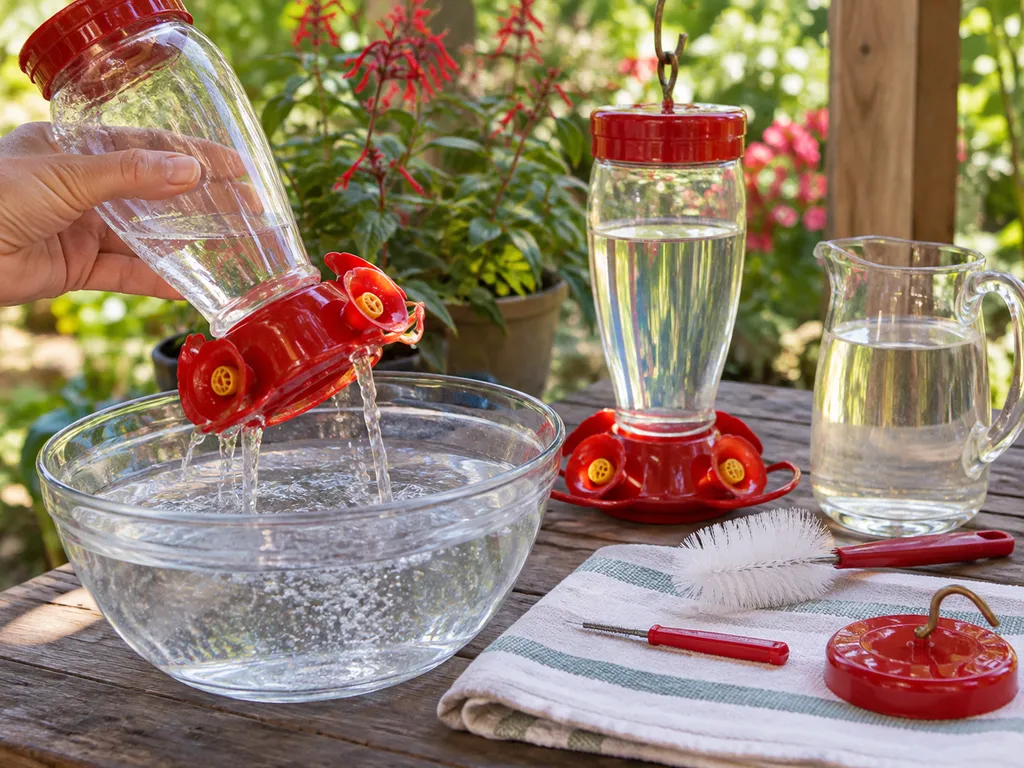
Replace nectar immediately if it turns cloudy, stringy, sour-smelling, or shows mold or black specks. Do not try to rescue old nectar by adding fresh nectar on top. Empty it, clean the feeder with hot water and a bottle brush, scrub the ports with a small brush or pipe cleaner, rinse thoroughly, and refill with a fresh 4:1 batch. The color of the nectar should never be used to hide freshness problems. Clear nectar makes changes easier to notice.
Common red dye myths
One myth says red nectar is needed because hummingbirds are “looking for red.” They do respond to bright visual cues, but the cue can be the feeder or flowers. Another myth says red dye makes the nectar closer to flowers. It does the opposite: natural nectar is clear, as Cornell and Audubon both note (source, source). A third myth says a stronger or more colorful mix is useful during migration or winter. Keep the 4:1 ratio in every season; changing the color or routinely strengthening the mix is not supported by the standard feeding guidance used here.
There is also a practical myth: that birds will ignore a feeder unless the liquid is red. Many backyard feeders use red plastic or glass accents, and hummingbirds investigate reliable sources over time. If visits are slow, the problem is more likely location, season, local flower abundance, feeder freshness, or normal territorial behavior. Dye is an easy thing to blame, but it is not the missing ingredient.
The best answer for a beginner
If you are setting up a hummingbird feeder for the first time, skip red dye from day one. Mix 1 part plain white table sugar with 4 parts water, stir until dissolved, cool if heated, and fill only with clear nectar. Choose a feeder with red parts if you want extra visibility. Clean the feeder at every refill, and replace the nectar sooner in hot weather. That routine answers the red dye question completely: hummingbirds need the energy in fresh sugar water, not colored liquid.
This approach also makes future decisions easier. When an ingredient is not plain white table sugar or clean water, leave it out. When a product promises convenience but adds coloring, leave it on the shelf. When nectar stops looking clear and fresh, replace it. Good hummingbird feeding is not complicated; it is mostly consistency, cleanliness, and restraint.
The Bottom Line
Hummingbirds do not need red dye, and there is no good reason to add it to nectar. Natural nectar is clear, and trusted bird authorities advise plain white table sugar and water only. Use clear 4:1 nectar, rely on red feeder parts or tubular flowers for visibility, and change the nectar often enough that it stays fresh.
Frequently Asked Questions
Do hummingbirds need red dye to find a feeder?
No. Hummingbirds can notice red feeder parts, red or orange flowers, and other visual cues while the nectar stays clear. The liquid does not need to be red.
Is clear nectar less attractive than red nectar?
Clear nectar is the right choice. Freshness, feeder visibility, and a reliable location matter more than coloring the liquid. Natural flower nectar is clear.
What should I put in hummingbird nectar instead of red dye?
Use only plain white table sugar and water at the 4:1 ratio: 1 part sugar to 4 parts water. Do not add coloring, honey, raw sugars, syrups, sweeteners, or supplements.
Can I use a red feeder with clear nectar?
Yes. A feeder with red parts is a good way to provide a visual cue while keeping the nectar clear. The red should be on the feeder, not in the sugar water.
Should I throw away red commercial hummingbird nectar?
If it contains artificial color, the conservative choice is not to use it. Plain homemade 4:1 nectar is simple, clear, and supported by bird-feeding authorities.
How often should clear hummingbird nectar be changed?
Change it about every 1 to 2 days above 90°F, every 2 to 3 days in the 80s°F, and every 4 to 6 days in cooler weather. Replace it immediately if it looks cloudy, stringy, sour-smelling, or moldy.
Sources
This guide was researched using these sources.
- https://www.allaboutbirds.org/news/should-i-use-red-food-coloring-in-hummingbird-food
- https://www.audubon.org/magazine/hummingbird-feeding-faqs
- https://www.audubon.org/magazine/are-hummingbirds-really-attracted-red-and-dyeing-their-food-safe
- https://www.fws.gov/sites/default/files/documents/2025-01/01.29.2025-learn-more-about-bird-feeding-vyfwc.pdf
- https://www.allaboutbirds.org/guide/Ruby-throated_Hummingbird/overview