
 Pin it
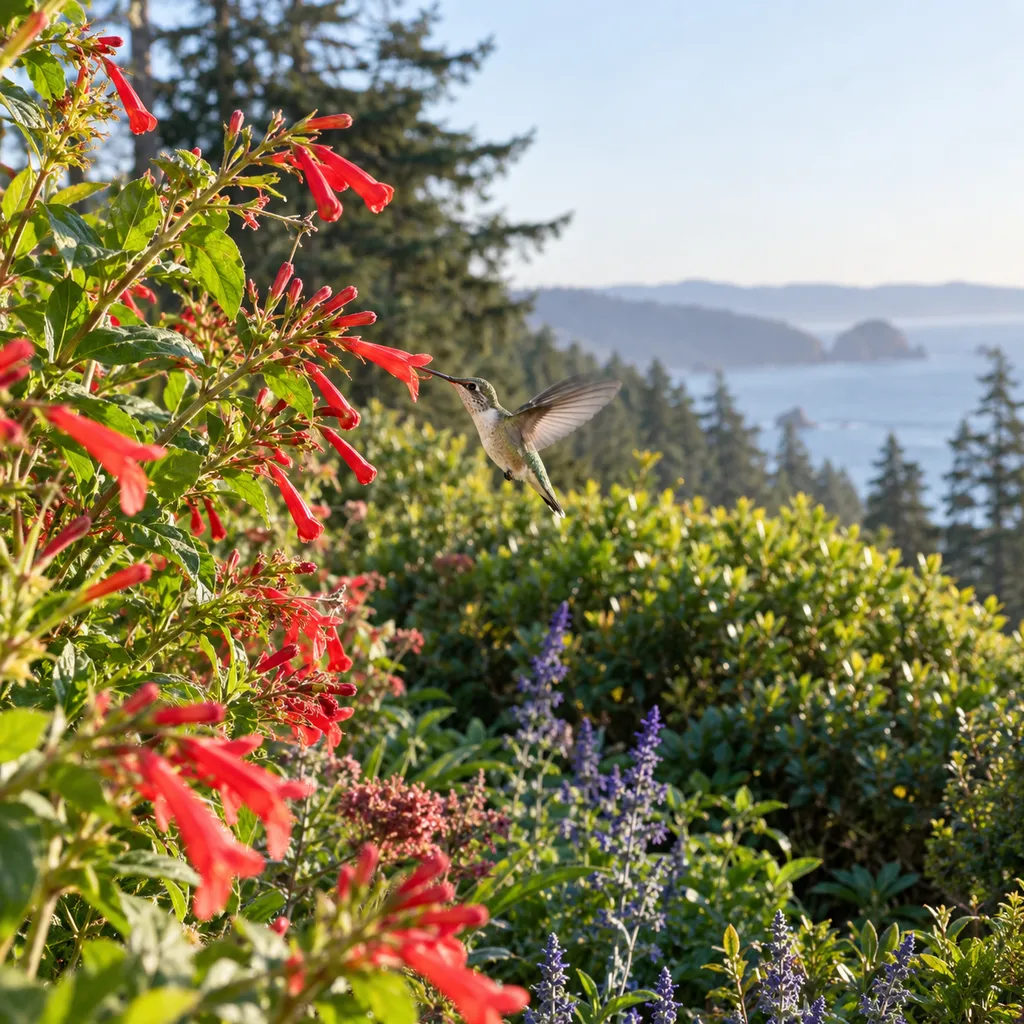
Anna's Hummingbird is the hummingbird many West Coast readers see when they think the season should be too cold for hummingbirds at all. It is a year-round resident in much of its range, especially along the Pacific Coast, and it uses a mix of flowers, small insects and spiders, sap sources, and fresh 4:1 sugar-water feeders where people maintain them responsibly. Cornell's All About Birds describes Anna's Hummingbirds as common along the Pacific Coast and notes that they do not migrate much compared with most North American hummingbirds https://www.allaboutbirds.org/guide/Annas_Hummingbird/overview.
Why Anna's Hummingbird stands out
Anna's Hummingbird, Calypte anna, is not the only western hummingbird, but it is one of the easiest to notice because it is vocal, territorial, and often present in winter. Audubon calls it a permanent resident along the Pacific Coast in many areas, with males giving a buzzy song from exposed perches https://www.audubon.org/field-guide/bird/annas-hummingbird. That song matters for backyard watchers because many hummingbirds are located first by motion, while Anna's Hummingbird is often located by sound: a scratchy set of buzzes, chips, and thin whistles that can seem too loud and raspy for such a small bird.
The simplest way to think about this species is as a western generalist with a strong relationship to gardens and edge habitats. It uses natural places such as coastal scrub, open oak woodland, chaparral, streamside groves, and canyons, but it also makes heavy use of parks, residential streets, and yards. Cornell lists yards, parks, residential streets, eucalyptus groves, riverside woods, savannahs, and coastal scrub among its common settings https://www.allaboutbirds.org/guide/Annas_Hummingbird/id. For a reader trying to understand why one hummingbird keeps showing up outside the kitchen window in January, that mix of adaptability and year-round food access is the key.
Where it lives and why it often stays
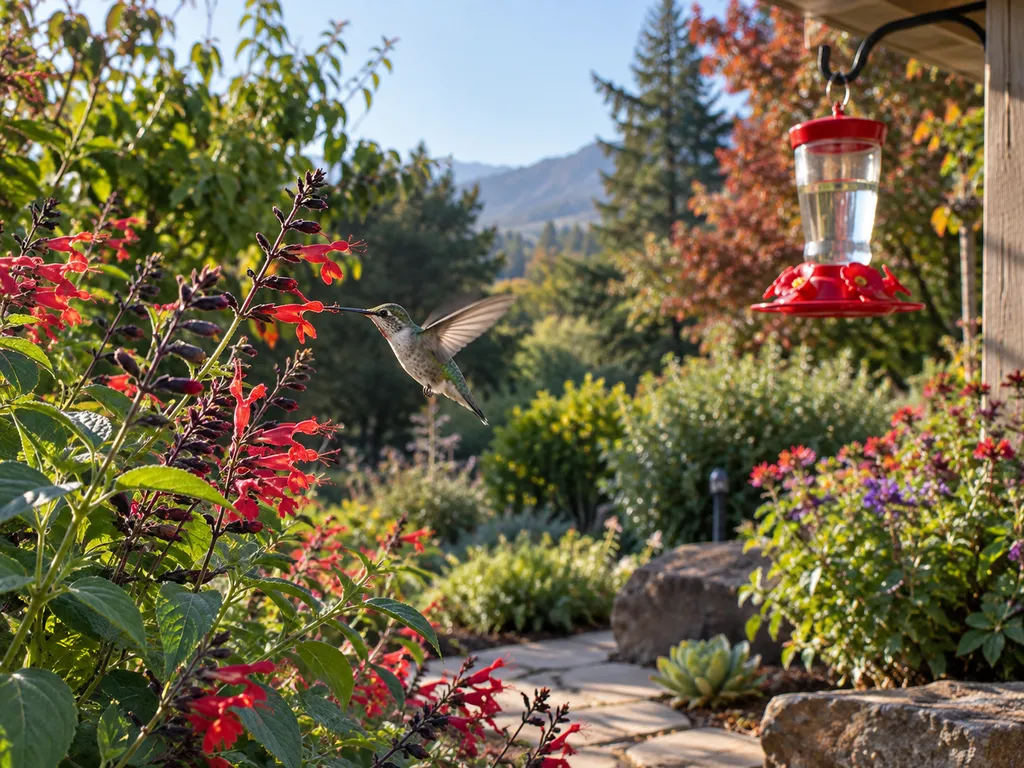
Anna's Hummingbird is strongly associated with the Pacific Coast, but the modern story is broader than a narrow coastal strip. Cornell notes that in the first half of the twentieth century the species bred only in northern Baja California and southern California, then expanded as flowering trees and gardens supplied more food and nesting places https://www.allaboutbirds.org/guide/Annas_Hummingbird/overview. Audubon likewise describes a recent range expansion helped by flowers and feeders in suburban gardens, with nesting now extending north to British Columbia and east to Arizona https://www.audubon.org/field-guide/bird/annas-hummingbird.
Its movement pattern is one reason it feels different from Ruby-throated or Rufous Hummingbirds. Cornell's range map says that, unlike most North American hummingbirds, Anna's Hummingbirds either do not migrate or move only short distances to better feeding grounds https://www.allaboutbirds.org/guide/Annas_Hummingbird/maps-range. Audubon adds that some southwestern birds make east-west movements, with many Arizona birds moving west after nesting and returning later in summer, while others remain permanent residents. So the most accurate answer is not that every Anna's Hummingbird stays in one yard all year. The better answer is that the species is often resident or locally mobile rather than a long-distance migrant.
- Most expected: coastal and lowland parts of California, Oregon, Washington, and nearby western regions where mild winters and flowering landscapes support them.
- Also regular: parts of the Southwest and western urban areas, especially where irrigated gardens and winter-blooming plants are common.
- Not impossible elsewhere: vagrants and unusual winter records can occur, but a local bird guide or regional sighting map is the right way to confirm out-of-range birds.
Field clues that help without overpromising
Identification starts with shape and behavior, not just color. Cornell describes Anna's Hummingbird as stocky for a hummingbird, with a straight bill, fairly broad tail, and tail extending beyond the wingtips when perched https://www.allaboutbirds.org/guide/Annas_Hummingbird/id. Adult males can show a glowing rose-pink throat and crown, but the same feathers may look dark, grayish, or brownish when the angle of light changes. That is why a male may seem to vanish from brilliant pink to plain dark in a single head turn.
Females and immature birds are subtler. Cornell describes females and immature males as metallic green above with some reddish-pink on the throat, and notes that females can show green upperparts, grayish underparts, bits of reddish spotting on the throat, and a pale line over the eye https://www.allaboutbirds.org/guide/Annas_Hummingbird/id. Oregon State University Extension gives similar Pacific Northwest field notes: adult males are very vocal with a fuchsia-pink gorget that also covers the head, while adult females are green-backed and grayish below with possible rose on the throat https://extension.oregonstate.edu/gardening/pollinators/hummingbird-visitors-pacific-northwest-gardens. Use those clues together, and be cautious with single-glimpse sightings.
What Anna's Hummingbirds eat
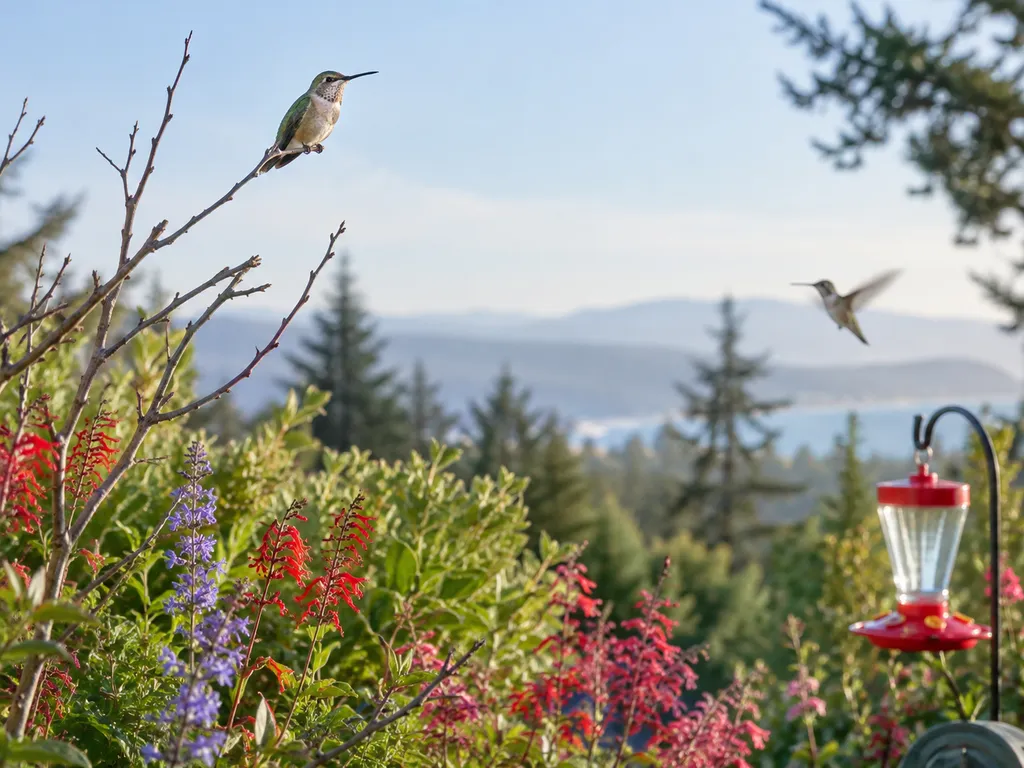
Anna's Hummingbirds visit flowers for nectar, but nectar is not the whole feeding story. Cornell says they hover before flowers looking for nectar and insects, and Oregon State University Extension notes that hummingbirds get important food from small insects and arachnids as well as nectar https://www.allaboutbirds.org/guide/Annas_Hummingbird/id https://extension.oregonstate.edu/gardening/pollinators/hummingbird-visitors-pacific-northwest-gardens. That is especially important around nesting, when adults collect tiny prey for growing young. A tidy yard with no flowers and very few insects is less useful than a yard with layered plants, blooms across seasons, and low-toxicity garden practices.
If you offer nectar, keep it simple and safe: use the 4:1 ratio, meaning 1 part plain white table sugar to 4 parts water. Cornell's backyard guidance for Anna's Hummingbird gives the same basic mix and says not to use honey or food coloring https://www.allaboutbirds.org/guide/Annas_Hummingbird/overview. Boiling is optional; it can help dissolve sugar, but the nectar must be completely cool before filling. Clean the feeder at every refill, and replace nectar quickly when it is cloudy, stringy, sour-smelling, moldy, or dotted with black specks. On this food-focused site, the feeder itself is only the container; the point is fresh, clear nectar and a yard that also supports natural food.
Courtship, song, and the famous dive
Male Anna's Hummingbirds are unusually showy singers for hummingbirds. Cornell's sound guide says the song can last 10 seconds or more, moving through buzzes, a clearer whistle, and emphatic chip notes https://www.allaboutbirds.org/guide/Annas_Hummingbird/sounds. A singing male often perches above head level in a shrub or small tree, which means the best first move is often to pause and listen before scanning every flower. The sound is not melodious in the way many songbirds are melodious, but once learned it is a strong clue for this species.
The courtship dive is even more dramatic. Cornell describes males climbing as high as 130 feet, then diving steeply and making a short high-pitched noise produced by air passing through the tail feathers https://www.allaboutbirds.org/guide/Annas_Hummingbird/lifehistory. The overview page adds that the display lasts about 12 seconds and may be oriented on sunny days so the iridescent throat and crown reflect toward the display target https://www.allaboutbirds.org/guide/Annas_Hummingbird/overview. In a yard, that can look like a tiny bird launching upward, vanishing into brightness, then dropping back with a sudden pop or squeak.
Nesting is small, early, and best left alone
Anna's Hummingbirds can nest early compared with many familiar backyard birds. Audubon notes that nesting may begin in December or even earlier, with nest sites varying from branches of trees and shrubs to vines, wires, or sheltered building edges, usually several feet above ground https://www.audubon.org/field-guide/bird/annas-hummingbird. Cornell lists a typical clutch of 2 white eggs, an incubation period of about 16 days, and a nestling period of about 20 days https://www.allaboutbirds.org/guide/Annas_Hummingbird/lifehistory.
How to make a yard more useful to Anna's Hummingbirds
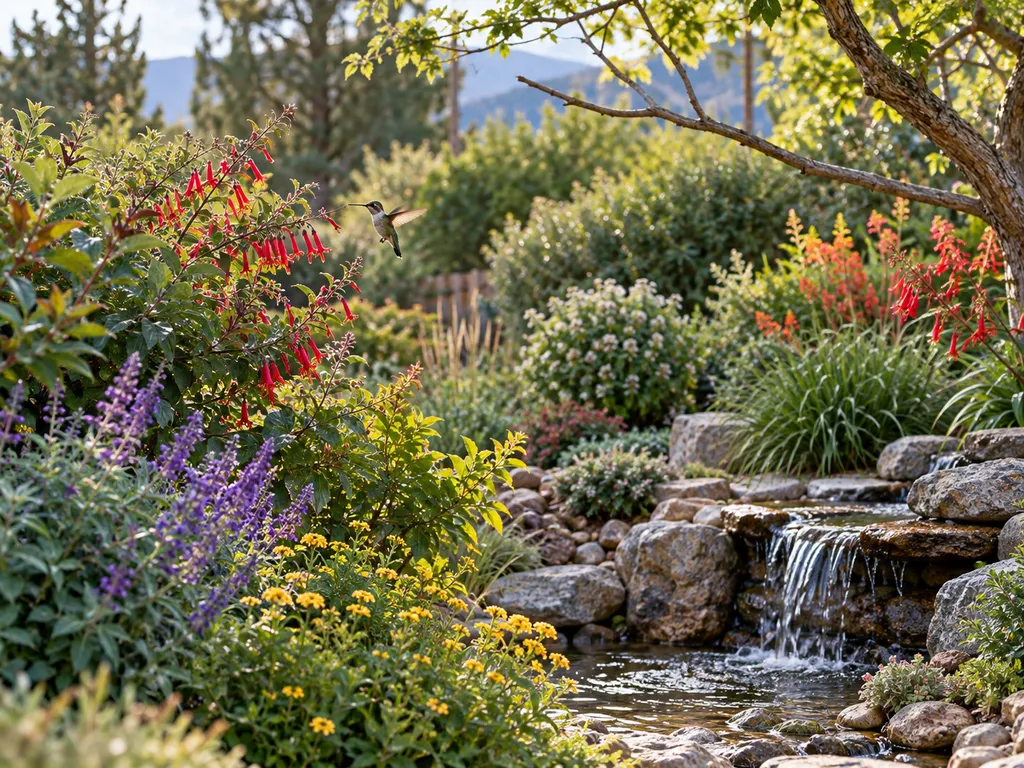
A good Anna's Hummingbird yard does not depend on one object. It combines flowers, tiny prey, cover, water mist or shallow moving water where appropriate, and clear nectar that is changed often. Oregon State University Extension recommends planting flowers, adding water, using gardening approaches that support insects, keeping cats indoors for bird safety, and encouraging neighboring habitat so the area works at a larger scale https://extension.oregonstate.edu/gardening/pollinators/hummingbird-visitors-pacific-northwest-gardens. For Anna's Hummingbird, winter-blooming and early-blooming plants can be especially helpful in mild western regions where the birds remain through colder months.
Choose plants for your region rather than copying a plant list from another climate. In the West, hummingbird gardens often include tubular red, orange, pink, or purple flowers such as penstemon, columbine, salvia, bee balm, fuchsia, and native honeysuckles where they are locally appropriate. The practical goal is continuous bloom, not one spectacular week. Also leave room for shrubs or small trees that provide perches. A male Anna's Hummingbird may guard a favored flowering patch or feeder, and a high exposed twig can become his singing station.
How it differs from other western hummingbirds
Anna's Hummingbird overlaps with other western species, including Rufous, Allen's, Costa's, Black-chinned, and Calliope Hummingbirds in parts of its range. The combination of year-round presence, stocky shape, straight bill, broad tail, male rose-pink head and throat, and scratchy song helps separate it in many everyday backyard situations. Color alone can mislead because light changes iridescence, and young males can be patchy. Behavior helps: an Anna's male may perch and sing repeatedly, while some other hummingbirds are less vocal around yards. Audubon also notes that Anna's tends to hold the tail still while hovering, unlike Black-chinned or Costa's in its description https://www.audubon.org/field-guide/bird/annas-hummingbird.
Conservation status and what backyard watchers can do
Anna's Hummingbird is not currently treated as a high-concern species by the main public bird guides cited here. Cornell's life history account says populations increased by more than 2 percent per year between 1966 and 2019 in the North American Breeding Bird Survey, and it describes the species as the most common hummingbird on the U.S. West Coast, thriving alongside human habitation https://www.allaboutbirds.org/guide/Annas_Hummingbird/lifehistory. That does not make every yard harmless. Outdoor cats, pesticide-heavy landscapes, dirty nectar, and window collisions can all turn a usable patch into a risky one. The best backyard support is ordinary and consistent: fresh clear nectar if you feed, a changing sequence of flowers, fewer poisons, safer windows, and no disturbance at nests.
The main takeaway is simple: Anna's Hummingbird is a resilient western hummingbird, but its success around people depends on the quality of the habitat people create. A yard with fresh 4:1 nectar, tubular flowers, insects, clean water features, sheltered perches, and respect for nests supports the bird's real needs better than any single feeder or bright decoration. Watch for the perched singer, the sudden flash of rose-pink, and the steep display dive, and you will start to read this familiar bird as a full neighbor rather than just a blur at the flowers.
The Bottom Line
Anna's Hummingbird is the year-round hummingbird many people notice in western yards, especially along the Pacific Coast. It is small and stocky, often vocal, and well adapted to gardens, parks, open woods, coastal scrub, and neighborhoods with flowers and responsibly maintained feeders. Males can show a rose-pink head and throat, but light can make those feathers look dark; females and immature birds are greener and grayer with limited pink on the throat. Support them with region-appropriate flowers, insects and spiders, safe perches, clean feeders filled with clear 4:1 nectar, and a hands-off approach to nests and chicks.
Frequently Asked Questions
Is Anna's Hummingbird really present in winter?
Yes, in much of its western range it can be present all year. Cornell says Anna's Hummingbirds either do not migrate or move only short distances to better feeding grounds, while Audubon describes them as permanent residents along the Pacific Coast in many areas.
What does Anna's Hummingbird eat besides flower nectar?
It feeds on flower nectar and also catches small insects and spiders. That is why a useful yard includes flowers, shrubs, and insect-supporting garden practices, not only a feeder.
What nectar ratio should I use for Anna's Hummingbird?
Use the standard 4:1 ratio: 1 part plain white table sugar to 4 parts water. Do not add red dye, honey, brown sugar, raw sugar, artificial sweeteners, or additives. Let nectar cool fully before filling if you warmed or boiled the water.
How can I recognize a male Anna's Hummingbird?
An adult male may show a rose-pink throat and crown, green upperparts, and grayish underparts. The color can look dark in poor light, so combine plumage with shape, behavior, range, and the male's scratchy song.
Should I move an Anna's Hummingbird nest if it is in an awkward place?
No. Do not move nests, eggs, chicks, or birds. In the United States, migratory birds and their nests and eggs are protected under federal law. If you believe a bird is injured or a nest is in immediate danger, contact a licensed wildlife rehabilitator or state wildlife agency.
Sources
This guide was researched using these sources.
- https://www.allaboutbirds.org/guide/Annas_Hummingbird/overview
- https://www.allaboutbirds.org/guide/Annas_Hummingbird/id
- https://www.allaboutbirds.org/guide/Annas_Hummingbird/maps-range
- https://www.allaboutbirds.org/guide/Annas_Hummingbird/lifehistory
- https://www.allaboutbirds.org/guide/Annas_Hummingbird/sounds
- https://www.audubon.org/field-guide/bird/annas-hummingbird
- https://extension.oregonstate.edu/gardening/pollinators/hummingbird-visitors-pacific-northwest-gardens
- https://www.fws.gov/sites/default/files/documents/2025-01/mbpm-2-nest-memorandum-2025.pdf